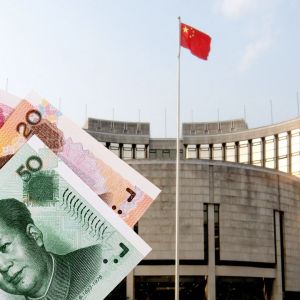
China ramped up efforts to internationalize the Yuan, taking advantage of declining global confidence in the U.S. dollar and expanding foreign investors’ access to domestic financial markets. In March, Chinese state media urged the government to push yuan stablecoins to challenge U.S. dollar stablecoin dominance. People’s Bank of China Governor Pan Gongsheng also proposed steps to reduce reliance on the U.S. dollar, including plans for a digital Yuan internationalization centre in Shanghai and expanded trading in Yuan FX futures. The Shanghai, Dalian, and Zhengzhou exchanges recently opened 16 additional futures and options contracts as part of a broader push to embed the Yuan more deeply into global commodity pricing and financial transactions. The push came as the U.S. dollar index has slid more than 9% this year, while the offshore Yuan gained over 2%. Zhou points out what could increase the influence of the Yuan globally China doubling down on the yuan as USD confidence wavers = power shift in motion. Global liquidity is watching. When trust erodes in the reserve currency, hard assets and alternatives shine. BTC wasn’t built by accident. — Jonathan V. Chicoine (@JVChicoine) June 25, 2025 Zhou Ji from Nanhua Futures, said the addition of 16 more futures and options contracts listed in mainland China increased the influence of the Yuan in the global commodity pricing system. Earlier this year, Chinese authorities reportedly announced a 500-Yuan fee waiver for international financial institutions to open a local account to access the bond market. A report published last month by the U.S. Federal Reserve revealed that Chinese banks preferred the yuan to the U.S. dollar when lending to emerging market economies. China also promoted the settlement of bilateral trade in Yuan, and it announced that Hong Kong businesses could access Yuan-denominated financing following a $100 billion boost in February. Bear Huo, FundPark’s China General Manager, said Chinese authorities also subsidized some interest costs for loans denominated in offshore Yuan. “China appears to be accelerating its de-dollarization efforts, though progress remains uneven.” – Dan Wang , Director of Eurasia Group’s China team In May, the Shanghai Futures Exchange also gathered feedback for a proposal allowing foreign currency collateral for Yuan-settled trades, another step toward encouraging global investors to use the Yuan. Other recent incremental initiatives include China allowing qualified foreign investors to participate in on-exchange exchange-traded fund options trading from Oct. 9 for hedging purposes. China’s Securities Regulatory Commission relaxed restrictions on qualified foreign investors’ participation in domestic commodity futures, commodity options, ETF options, and other products. Analysts say the U.S. dollar is ‘almost impregnable’ Paul Blustein, Senior Associate (non-resident) at the Center for Strategic and International Studies, defended the U.S. dollar, claiming that its dominance was almost “impregnable,” unless the U.S. committed “catastrophic” policy errors. He added that the idea that people would soon be carrying China’s digital yuan on their phones, transmitting personal data to the Communist Party, was far-fetched. According to Blustein, China should establish a rule of law allowing investors to trust its courts and move capital freely. Matt Gertken, Chief Geopolitical Strategist at BCA Research, also agreed with Blustein’s sentiment, arguing that China had yet to present itself as a dependable alternative. He claimed that China’s rule of law was inferior to the U.S., and it did not offer a large and deep pool of liquid assets that was open to foreign investors like the U.S. Gertken believes that Beijing has not been sufficiently addressing the geopolitical risks tied to its markets. However, a report by the Official Monetary and Financial Institutions Forum ( OMFIF ) claimed that central bank reserves were eyeing a move away from the greenback into China’s yuan. 30% of central banks expected to increase Yuan holdings as its share of global reserves tripled to 6%. 16% of central banks also picked the Yuan as the second most in-demand currency after the Euro, with plans to increase their holdings over the next 12 to 24 months. The dollar, the most popular currency in last year’s survey, fell to seventh place this year, with 70% of those surveyed saying the U.S. political environment discouraged them from investing in the dollar–more than twice the share a year ago. Cryptopolitan Academy: Want to grow your money in 2025? Learn how to do it with DeFi in our upcoming webclass. Save Your Spot