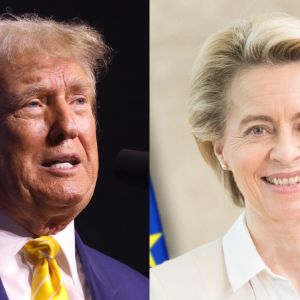
The White House confirmed Sunday that the United States has finalized a new trade deal with the European Union after direct talks between President Donald Trump and European Commission President Ursula von der Leyen in Washington. The agreement landed just ahead of the August 1 deadline that would have triggered new tariffs, ending weeks of economic tension between the two major economies. This report is based on content provided by the original briefing details shared earlier this week. Trump said the U.S. will now impose a 15% tariff on most goods coming in from Europe, including vehicles. He described it as “a very powerful deal,” and repeatedly called it “the biggest of all the deals.” Von der Leyen, who appeared with him , acknowledged the deal came after “tough negotiations” but said it was ultimately “a huge deal.” The two leaders stood together at the press conference, spelling out the terms and attempting to project stability after weeks of friction over trade policy. Some goods, like aircraft, their parts, select chemicals, and pharmaceuticals, will not face the 15% tariff. Von der Leyen made it clear that these exceptions would stand, and emphasized that the new tariff rate will not stack on top of existing duties. This was a sticking point during negotiations, especially for countries like Germany and France, whose industries are heavily reliant on exports in those exempted sectors. EU agrees to spend big in exchange for tariff cap In return for the U.S. capping the tariff at 15% instead of the threatened 30%, the EU agreed to buy $750 billion worth of U.S. energy and also invest an additional $600 billion in the American economy. These commitments, Trump said, go beyond previous levels and will be directed at a range of sectors. He did not share any specific breakdowns or timelines. The president also claimed that the EU will be “purchasing hundreds of billions of dollars worth of military equipment,” though no specific figures were disclosed. The defense side of the agreement raised eyebrows, with some officials noting that past military spending pledges from U.S. allies have often moved slowly, if at all. Before the deal was finalized, Trump said there was only a “50-50 chance” that he and von der Leyen would strike any kind of framework. On the EU’s side, Brussels had already started preparing for a collapse. Lawmakers had approved a counter-tariff package aimed at targeting U.S. goods and were reportedly getting ready to trigger the Anti-Coercion Instrument, known as the “trade bazooka” inside EU circles. That tool is considered a last-resort mechanism for hitting back against economic pressure from major global players. Ireland and Germany respond, numbers reveal scale Irish Prime Minister Micheál Martin welcomed the agreement, saying it “brings clarity and predictability” to the U.S.-EU trade relationship. His office, however, warned that the higher tariffs would “make trade more expensive and more challenging.” The Department of the Taoiseach said the agreement still represented a step toward “a new era of stability,” but one that comes with clear trade-offs. German Chancellor Friedrich Merz responded with cautious support, focusing on what the deal means for the auto industry. He pointed out that the previous 27.5% tariff rate on cars had now been “almost halved,” and called the quick adjustment “of great significance” to Germany’s export-focused economy. Germany had been pushing hard for car tariff relief throughout the talks. The broader U.S.-EU trade relationship is massive. In 2024, total trade in both goods and services between the two hit 1.68 trillion euros, which is around $1.97 trillion. While the EU ran a surplus in goods trading, it recorded a deficit in services, leading to an overall surplus of 50 billion euros with the U.S. last year. The shift to a 15% tariff structure is expected to have a major effect on that balance, especially for sectors that rely on consistent cross-border flows like machinery, autos, and pharmaceuticals. Cryptopolitan Academy: Want to grow your money in 2025? Learn how to do it with DeFi in our upcoming webclass. Save Your Spot