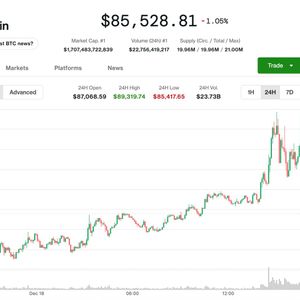
Summary BitFuFu is deeply undervalued versus peers, trading at a forward EV/Sales of 1.23x compared to RIOT's 9.31x and MARA's 7.62x. FUFU's cloud mining business provides revenue stability, positive net income since 2021, and acts as a hedge against Bitcoin volatility. Despite market concerns over supplier reliance and regulatory risks, BitFuFu is not exposed to U.S. cloud mining regulation and is misunderstood by the market. I expect a strong comeback for BitFuFu as crypto market fears appear overblown and institutional adoption of Bitcoin strengthens the sector's fundamentals. Now is not an easy time to be a crypto investor. After reaching a high of over $124,000, Bitcoin prices have dropped to around $86,000. Just a couple of weeks ago, BTC was trading for less than $84,500 as well, so we have indeed seen some recovery from those lows. That said, BTC is still down ~17% in the past 6 months, so it is too early to jump to the conclusion that Bitcoin is in recovery mode. This could very well be a dead-cat bounce before a resumption of the downward trend. A closer evaluation of the three major crypto winters we have witnessed in the past decade suggests Bitcoin is likely to fall dramatically from here if we are indeed in a crypto winter as some investors/analysts suggest. Investing is all about taking calculated risks. Strategic asset allocation decisions go a long way in helping investors eventually beat the market in the long run. For me, personally, allocating a small percentage of my assets to contrarian bets that could deliver handsome returns has always been a lucrative strategy. This is where BitFuFu Inc. ( FUFU ) comes in. My close followers should remember that I found BitFuFu an attractive bet a few months ago, given how cheaply valued it was from a market cap/hashrate comparison perspective. Amid the crypto market downturn (more on that later), crypto stocks have been decimated, to say the least. As the below chart illustrates, BitFuFu, Riot Platforms ( RIOT ), and MARA Holdings ( MARA ) have all received a beating from the market in the past month. Exhibit 1: 3-month stock market performance of FUFU, RIOT, and MARA Data by YCharts FUFU has lost 35% of its market value in the past 3 months, while RIOT and MARA have lost 26% and 42% of their market value, respectively. RIOT, however, remains the best-performing stock among these three stocks in 2025. As I argue in this analysis, all macro indicators point to a recovery in Bitcoin prices in 2026 and that we are just going through a highly volatile time period for Bitcoin, not entering a crypto winter that could keep prices depressed for a long period of time. Based on these assumptions, I find FUFU significantly undervalued compared to its peers, which leaves a long runway for FUFU stock to grow once Bitcoin turns a corner. BitFuFu's Cloud Mining Business Strength Is A Drag On Market Performance In The Short Run As close followers of the company should know, BitFuFu is not a self-miner. Although the company does have a self-mining business unit, BitFuFu generates the bulk of its revenue from its cloud mining business, where it provides hash power to retail users. As illustrated below, in Q3, the cloud mining business accounted for 68% of revenue while the self-mining business accounted for just ~11% of revenue. Exhibit 2: BitFuFu's Q3 revenue breakdown by segment Q3 press release BitFuFu has a strategic partnership with Bitmain to lease or buy hashrate in bulk. The company then enters into contracts with retail users to sell this hashrate at a markup. The company brings in revenue through different types of fees, including a service fee which is charged upfront and also an electricity/maintenance fee. The company, in the past couple of years, has grown its cloud mining customer base exponentially (total registered users of ~641,000 as of Q3 2025). This was the primary driver of revenue growth in recent times (in Q3, BitFuFu’s revenue doubled YoY to $180.7 million). BitFuFu’s cloud mining business is what differentiates the company from self-miners such as Riot. Unlike Riot, which is essentially a leveraged bet on crypto prices, BitFuFu gives investors exposure to a crypto services business thanks to the strength of its cloud mining business. This is exactly why BitFuFu has been able to turn profitable while bringing in reasonable cash flows. Exhibit 3: BitFuFu’s recent growth in revenue, adjusted EBITDA, and net income Investor presentation BitFuFu’s cloud mining business also acts as a hedge against Bitcoin volatility. This is already evidenced by the fact that FUFU stock has lost far less in market value compared to both RIOT and MARA during this downturn in the past few months. Unlike a self-mining business, BitFuFu’s business model allows the company to have better revenue visibility as it charges service fees from cloud mining customers. In addition to this, the strength of the cloud mining business has also created an asset-light business model for BitFuFu given that the company does not have to invest in infrastructure to generate revenue (BitFuFu leases hashrate from Bitmain). Despite these benefits, I believe BitFuFu’s cloud mining strength has introduced some risks that are now being punished by the market. For instance, BitFuFu relies heavily on its partnership with Bitmain to drive the growth of the cloud mining business. For now, there have been no cracks in this partnership, but with a long-term view, it is reasonable to apply a valuation discount to the company given its reliance on one supplier. Any changes to the currently favorable contract terms may result in a deterioration in BitFuFu’s profitability in the future. There is a regulatory risk looming on the horizon for many cloud mining solutions providers in the United States. If cloud mining contracts with customers are classified as investment contracts by the SEC, these contracts would be treated as unregistered securities. If this happens, cloud miners could be forced to shut down their cloud mining operations in the United States. BitFuFu, however, is not exposed to this risk as its cloud mining business is not open to U.S. investors, but the company, unfortunately, is being treated as if its cloud mining business is exposed to this regulatory threat. This explains the valuation disparity between FUFU and its self-mining peers. However, in the long run, we should see this anomaly normalize, helping BitFuFu’s valuation merge towards that of its peer group. BitFuFu’s cloud mining business is a net positive for shareholders, but at a time when crypto markets are experiencing increased volatility, the market seems to be overly cautious of the risks posed by BitFuFu’s business model. Bitcoin Is In A Fundamentally Stronger Position Compared To Previous Crypto Winters Since 2013, there have been three main crypto winters. December 2013 to January 2015 (BTC declined 75%). December 2017 to December 2018 (BTC declined 83%). November 2021 to November 2022 (BTC declined 73%). October has generally been a very strong month for Bitcoin historically, but this year, the crypto market rout actually began in October. As you can see above, in each of the three crypto winters, the decline of Bitcoin’s market value has been rapid and staggering. So far, Bitcoin has shed about 35% of its value from recent highs. Going by historical data, if we are indeed in the early stages of a crypto winter, Bitcoin has far more to lose before staging a recovery. However, there are two reasons to believe that Bitcoin is in a fundamentally stronger position today. A crypto winter of historical scale, therefore, seems like a distant reality today. First, unlike in the past, we are seeing a strong interest in Bitcoin and cryptos among institutional investors. This is a major development. The ownership base for cryptos has expanded to large-scale sovereign wealth funds following favorable regulatory developments (more on that below). Earlier this year, Mubadala (the sovereign wealth fund of Abu Dhabi) revealed a $400 million stake in BTC. In addition, some companies (MicroStrategy is a classic example) are using BTC as a corporate treasury option today, replacing traditional corporate debt. Second, there is strong regulatory support for Bitcoin adoption today, unlike in the past where regulatory clarity lacked. As illustrated below, some of the leading global economies have made stellar progress since early 2024 to promote the use of Bitcoin, including institutional adoption. The SEC’s approval of a first-ever Bitcoin spot ETF in January 2024 has paved the way for institutional investors to take a more positive stance on BTC. Exhibit 4: Recent regulatory milestones State Street Investment Management The GENIUS Act, which was signed into law last July, marks a major milestone in the U.S. as it has officially legalized the payment layer of cryptocurrencies. Now that payment stablecoins are no longer classified as securities, regulated financial institutions such as banks can easily merge cryptos with the banking system by taking custody of these assets. This is a major step forward in crypto adoption. Another major regulatory breakthrough came in late September when the SEC announced a ruling allowing large custodian banks to provide crypto custodian services. Following this decision, some of the largest players in this market such as BNY Mellon and State Street have already begun offering custodian services for stablecoin reserves. This decision has, therefore, removed a major barrier that prevented institutional investors from investing in cryptos. Based on these developments, it is evident that BTC is no longer a speculative asset. Bitcoin has matured enough to be considered as an investment vehicle by sovereign funds, large corporates, and other types of institutional investors. BTC is now exhibiting commodity-like characteristics, except for the high volatility. The Market Could Be Grossly Undervaluing BitFuFu So far in this analysis, I have established two factors. BitFuFu’s cloud mining business has a lot of advantages, but its strength has forced the market to apply a valuation discount amid the ongoing crypto market rout. The current crypto market slowdown does not seem to be the beginning of a crypto winter for two main reasons. Because of the crypto market slowdown and the risks associated with BitFuFu’s cloud mining business, the company is trading at a significant discount to its closest peers. The company is currently valued at a forward EV/Sales multiple of 1.23x, compared to 9.31x for Riot Platforms and 7.62x for Mara Holdings. Based on most valuation metrics, BitFuFu is the cheapest among its closest peers. What is even more noteworthy is that BitFuFu has reported positive net income every year since 2021 whereas most of its peers have struggled to remain profitable consistently. This success comes down to the strength of BitFuFu’s cloud mining business. Assuming that market fears of a crypto winter are overblown, I believe we are looking at the possibility of a strong comeback from crypto stocks. FUFU, in my opinion, is the best-positioned stock for the strongest comeback among its peers given that it is substantially cheaper than its peers, which leaves a long runway for its stock price to increase. The company remains largely misunderstood in the market, which is the primary reason behind its market undervaluation. Risks For now, the biggest risk of investing in FUFU (or any other crypto miner for that matter) is a further deterioration of BTC prices. The only mechanism to manage this risk would be to invest in a diversified portfolio rather than concentrating on crypto stocks alone. In the long run, investors should keep an eye on the relationship between BitFuFu and Bitmain as any adverse developments here could materially impact BitFuFu's cloud mining business. The regulatory environment for cloud miners should also be monitored closely to understand inflection points from a regulatory perspective. Takeaway BitFuFu, with its diversified and flexible business operations, seems well-positioned to report strong earnings growth in the long run. The ongoing crypto market rout has resulted in investors unduly punishing FUFU. Although the company is likely to trade at a valuation discount to its closest peers in the long run (because of its exposure to the cloud mining business, supply-side risks, and its small-cap status), this does not mean that a valuation re-rating is not on the cards. In fact, the opposite is true as recent market fears have pushed the company into the deeply undervalued territory compared to its peers, presenting investors with a good opportunity to double down.