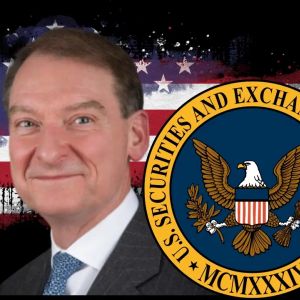
The world of digital assets has entered a brave new path courtesy of the U.S. Securities and Exchange Commission (SEC ) Chair Paul Atkins. Addressing the OECD Roundtable on Global Financial Markets, he argued for certainty in on-chain capital raising rules. He said entrepreneurs shouldn’t confront “endless legal uncertainty as they build in the U.S.” Atkins reiterated his belief that most crypto tokens are not securities, which directly contrasts with how the SEC has been doing things for the last 10 years. He stated the agency needs to cease relying on ad hoc enforcement under case law and provide clear, predictable road rules for entrepreneurs and investors. SEC charts a new course with rulemaking Atkins’ speech focused on Project Crypto, a wide-ranging regulatory operation that has the support of President Donald Trump’s administration. The project aims to update securities laws for the digital age and intends to help prepare capital markets to run fully on-chain. U.S. financial regulation has rested on analog-era principles for decades. Project Crypto aims to change that by rewriting fundamental rules that better suit blockchain, tokenized assets, and decentralized systems. Atkins believes that a system designed for paper stock certificates is ill-equipped to deal with tokenized equities, decentralized exchanges, or algorithmic stablecoins. This will entail the SEC issuing straightforward, consistent definitions around when a token is considered a security and when it is not. The clarity can be expected to assist investors, entrepreneurs, and exchanges in understanding how to come into compliance without fear of being sued out of the blue or accepting the regulatory interpretations of the day. Atkins said that recent years of regulatory inconsistency had throttled innovation and driven talent overseas. He told the OECD audience that American entrepreneurs had been forced to spend more money on lawsuits than on developing their products, adding that such a chapter now belonged to history. Project Crypto further provides a consolidated licensing process. Those activities could all fit under one regulatory umbrella, which is another kind of simplification to the industry, and would no longer need to apply for multiple such licenses. It hopes to reduce compliance costs and help a financial platform evolve into a “super app” by offering several services in one trusted, regulated place. Atkins likened the model to trends in Asia, where financial super-apps meld payments, savings, and trading all in one place. He cautioned that the United States could be left behind if other jurisdictions moved to reform their financial markets without similar changes. Industry observers say such a homogenized industry would enable big Wall Street players, fintech players, and native crypto platforms to all converge. Banks and exchanges would be able to standardize on tokenized securities, lending markets, and staking products, as long as they acted according to stringent investor-protection rules. Super-Apps and American innovation in the spotlight Atkins noted that global competition was intensifying, pointing to Europe’s MiCA framework as an example of how other regions were already setting standards for digital assets. He warned that the United States risked falling behind. Speaking at the OECD, he explained that the goal was to make American markets the launchpad for innovation and investment, to ensure American entrepreneurs could secure funding under strong investor protections, and to give consumers access to products that opened the door to these markets. He pushed for the “minimum effective dose” of regulation, rules that protect investors but still allow for innovation. That means room for tokenized securities, decentralized finance products, and new asset classes. As earlier reported by Cryptopolitan , the SEC chair had also announced a joint roundtable with the Commodity Futures Trading Commission (CFTC), set for Sept. 29. The session will discuss how to bring products such as perpetual contracts and DeFi trading back to the U.S. within the right regulatory framework. The two said, “As the markets for securities and non-securities increasingly converge, we are excited to embark on a new beginning for coordination between U.S. market regulators. The work of the SEC and CFTC has never been more intertwined—and the wave of innovation before us never more dependent on the depth of our cooperation.” Atkins’ comments underscore a major change in tack in Washington. This summer, Congress passed the first federal law regulating stablecoins, while the Clarity Act, a market-structure bill that would enshrine the SEC and CFTC’s authority, continues to advance. Join Bybit now and claim a $50 bonus in minutes