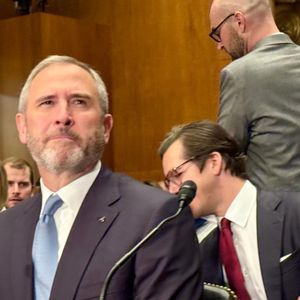
Crypto industry insiders including Ripple CEO Brad Garlinghouse outlined their hopes for how the Senate might seek to regulate digital assets markets in the U.S., while Senator Elizabeth Warren shared some of the top Democrat objections during a Wednesday hearing . "For the last decade, the legal and regulatory uncertainty surrounding crypto has prohibited meaningful progress in the U.S.," Garlinghouse told the Senate Banking Committee in his testimony. "At Ripple, we certainly saw firsthand how the lack of clear rules of the road can be weaponized to target good actors." Ripple was one of the companies sued by the Securities and Exchange Commission, during President Donald Trump's first term. This is one of two Senate committees — also including the Senate Agriculture Committee — that need to work through the wide-reaching crypto market structure bill. The banking panel has so far moved more quickly, but their agriculture counterparts just scheduled their own hearing for Tuesday. And for its part, the U.S. House of Representatives is set next week for what leaders are calling "Crypto Week" to pursue a number of pieces of legislation, including that chamber's own Digital Asset Market Clarity Act to establish legal infrastructure for the digital assets markets. Banking Committee Chairman Tim Scott, a South Carolina Republican, noted during Wednesday's hearing that he hoped the bipartisan momentum of the Senate's successful vote on its Guiding and Establishing National Innovation for U.S. Stablecoins of 2025 (GENIUS) Act — which the House will likely vote on next week as well — will continue as the panel turns toward the more important piece of crypto legislation. "Passing GENIUS is more than just a legislative win," Scott said of the bill to establish rules for U.S. stablecoin issuers, facing a House vote as soon as next week. "It’s a testament to what’s possible when Congress works together and puts principles before partisan politics." Senator Elizabeth Warren, the panel's ranking Democrat who is one of the industry's most reliable critics on Capitol Hill, opened her remarks on Wednesday suggesting there are a series of "principles that I think should guide our work," not completely shutting the door on participating in a negotiation. But one of those principles was the increasingly contentious point that President Donald Trump's personal interests in the crypto industry need to be dealt with. Read More: Trump's Crypto Ties Still Toxic With Some Dems, Including One Seen as Industry Ally "The crypto industry may be calling the shots for Republicans, but nobody wants weak crypto rules more than the President of the United States," Warren said. "If we're going to provide rules of the road for crypto, we need to shut down the superhighway for presidential corruption at the same time." She also said that proposals including the House's Clarity Act "will allow noncrypto companies to tokenize their assets in order to evade" regulation from the Securities and Exchange Commission. "Think for just a minute about what that means," Warren said. "Under the House bill, a publicly traded company like Meta or Tesla could simply decide to put its stock on the blockchain" to escape SEC scrutiny. The House's Clarity Act has already cleared the relevant committees in that chamber, so it's the piece of legislation furthest along and has been suggested by Scott as a template for Senate work on market structure. One of the key provisions in the bill is to set up the Commodity Futures Trading Commission as a primary regulator of U.S. digital assets activity. A former chairman of that agency, Tim Massad, was among the witnesses on Wednesday and was asked about his thoughts on the act. Massad responded, "I think it's got a lot of problems. I think it's 236 pages of regulatory arbitrage opportunities." Scott's committee has previously set out a series of guidelines for its own work on market structure legislation that will "recognize the need to clearly define what is a commodity, what is a security, and how digital assets can trade and be custodied in a way that fosters innovation while protecting investors," he said at the hearing. "We don’t need more roadblocks," he said. "We need rules that actually work." Trump has added urgency to the crypto policy debate in Congress at the moment, because he'd set his own August deadline for the Senate and House to produce stablecoin and market structure bills. While it's possible the House signs off on the Senate's stablecoin bill next week and sends it to the president to be signed into law, the timeline for the more complex bill may be further out. Senator Scott has declared a September 30 deadline for the Senate to finish market structure legislation.








![[LIVE] Crypto News Today: Latest Updates for Dec. 22, 2025 – Sector Rotation Pushes NFTs Higher; RWA and DeFi Extend Gains](https://resources.cryptocompare.com/news/52/56165057.jpeg "[LIVE] Crypto News Today: Latest Updates for Dec. 22, 2025 – Sector Rotation Pushes NFTs Higher; RWA and DeFi Extend Gains")

