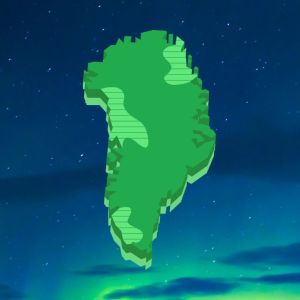
The fight for control over the world’s most important minerals is now reaching Greenland. The U.S. government, tech giants, and mining companies are circling the island for one reason: it’s full of rare earths, lithium, and graphite, all critical for things like AI, defense systems, and consumer electronics. Donald Trump, who is now the 47th U.S. president, has made it clear that Greenland is back on his radar. “We need Greenland for national security, not for minerals,” he said in December. But House Speaker Mike Johnson said this week that it’s about both: “national security and critical minerals and many other reasons.” There’s no argument over whether Greenland has what everyone wants. What’s up in the air is how much of it can be used, and how soon. Lawmakers act as China controls mineral refining The U.S. Geological Survey lists 60 minerals as critical. That includes neodymium and dysprosium, which power magnets and motors in tech hardware, and others like germanium and gallium, which are used in fiber optics, semiconductors, and power devices. The catch? The U.S. doesn’t control most of it. China does. Right now, China supplies 98% of gallium and about 60% of germanium worldwide. And it doesn’t just mine the stuff, it also runs the refining process too. That’s what gives it leverage. “There are lots of rare earths around the world, but the issue is refining them,” said Jack Lifton, who co-chairs the Critical Minerals Institute. “The American rare earth industry could fit inside of a large bus.” To change that, a bipartisan group of lawmakers introduced a bill last week to set up a $2.5 billion reserve of rare earths. The Pentagon is already involved. In July, the Department of Defense signed a 10-year deal with MP Materials, which runs a rare earth mine in Colorado, to strengthen the supply chain and cut ties with Chinese sources. That’s where Greenland comes in. The USGS says it holds some of the largest rare earth reserves in the world, and none of them are being mined right now. Industry experts disagree over Greenland’s mineral potential Ted Feldmann, who runs Durin Mining Technologies, says the minerals in Greenland might not be worth the cost. “I think it’s a great idea to expand America’s presence in Greenland to counter Russia and China,” Ted said. “But I don’t think we should go there for the minerals.” He points to the Tanbreez site in southern Greenland, calling it one of the biggest known rare earth deposits. But the percentage of useful metal in the ore is low. “It probably isn’t economically viable to ship,” Ted said. Still, others don’t agree. Eldur Olafsson, the CEO of Amaroq, is already mining gold in southern Greenland. He says it can work, with the right backing. “Denmark is not really a resource-driven country, so the capital support up until this date has not been enough to get more mining going,” Eldur said. He says it’s not just about the money. It takes people. Equipment. Roads. Bridges. Harbors. “You also need people. You need to physically move people and build infrastructure,” Eldur said. That’s tough in a place with only 60,000 people and brutal weather. But he’s not backing off. “Alaska, Canada, Norway, Sweden and Russia all have mines, some very big mines, across the Arctic region,” he said . “These are among the best mines you can find in the world.” Eldur says demand from tech is only going to grow. “We always need new mining areas, or we need to reprocess metal, to have enough metal for the revolution that is coming, which is AI and similar technology.” Greenland’s mining licenses grow but production stays low Right now, there are over 140 active licenses issued in Greenland for mineral exploration. But only two actual mines are operating. One of them is Eldur’s. That gap between interest and action shows how hard it is to get from paperwork to production. Even if the minerals are there, price swings can shut a mine down fast. That’s exactly what happened to the Black Angel mine near Maarmorilik. It produced lead and zinc from 1973 to 1990 and still has reserves left. But when zinc prices dropped, the mine closed and never reopened. That kind of risk makes investors nervous. And it’s why most of Greenland’s minerals are still stuck underground. The island has the third-largest land-based deposit of rare earths on the planet. But no one wants to take the first big step without clear payoffs. Still, with China calling the shots in rare earths and AI putting pressure on global supply chains, interest in Greenland is not going away. Sharpen your strategy with mentorship + daily ideas - 30 days free access to our trading program