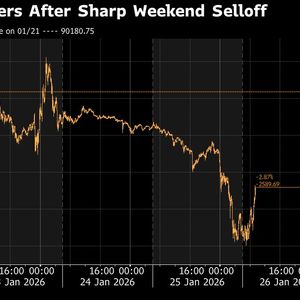
BitcoinWorld CME Bitcoin Futures Gap: The $2.9K Chasm Revealing Critical Market Mechanics In a stark display of cryptocurrency market mechanics, CME Group’s Bitcoin futures market opened on Monday, March 24, 2025, with a significant price gap of approximately $2,940. The regulated derivatives contract commenced trading at $86,560, notably lower than its previous Friday settlement of $89,500. This event immediately captured the attention of institutional and retail investors alike, serving as a real-time case study in the interplay between 24/7 digital asset markets and traditional financial trading hours. The CME Bitcoin futures gap is not merely a technical anomaly; it is a window into volatility, liquidity, and the ongoing convergence of crypto and mainstream finance. Decoding the CME Bitcoin Futures Gap Phenomenon The recurring appearance of a CME Bitcoin futures gap stems from a fundamental structural difference. The Chicago Mercantile Exchange (CME), a cornerstone of traditional finance, operates on a set schedule. Its Bitcoin futures market closes on Friday afternoon and reopens on Sunday evening, Central Time. Conversely, the global Bitcoin spot market—comprising hundreds of exchanges worldwide—trades continuously, 365 days a year. This creates a temporal disconnect. When the spot price moves significantly over the weekend without the futures market being open to reflect that movement, a gap emerges upon the Monday open. Market analysts consistently monitor the size and direction of these gaps as a volatility indicator. A larger gap, such as the $2.9K move observed, typically signals a weekend of heightened price action or impactful news in the underlying spot market. Several factors can drive this weekend volatility: Macroeconomic Announcements: Geopolitical events or economic data releases in other time zones. Cryptocurrency-Specific News: Protocol upgrades, regulatory statements, or major exchange developments. Liquidity Dynamics: Thinner weekend trading volumes can amplify price swings from large orders. The following table compares key characteristics of the CME futures market and the global Bitcoin spot market: Feature CME Bitcoin Futures Global Bitcoin Spot Market Trading Hours Set session times; closed weekends 24/7, continuous Regulatory Framework Heavily regulated by the CFTC Varies significantly by jurisdiction Primary Participants Institutional investors, hedge funds Mix of retail and institutional traders Price Discovery Derived from spot market reference rates Direct peer-to-peer and exchange trading Settlement Cash-settled in USD Often settled in actual Bitcoin The Mechanics of the Gap Fill Theory Following the Monday opening, a dominant question permeates trading desks: will the gap fill? The “gap fill” theory in technical analysis suggests that price often retraces to cover the empty space left on a chart. In the context of CME Bitcoin futures, this implies the futures price may move toward the prior Friday’s closing level of $89,500. However, this is not a guaranteed mechanical process. The futures price is fundamentally anchored to the spot price through arbitrage mechanisms. If the futures price is trading at a significant discount to the spot price (as it was upon opening), arbitrageurs may execute a strategy. They could buy the cheaper futures contract while simultaneously selling the equivalent amount of Bitcoin in the spot market, locking in a risk-free profit if the price difference covers transaction costs. This collective action creates buying pressure on futures and selling pressure on spot, pushing the two prices toward convergence. Consequently, the futures gap often closes not because of a mystical chart pattern, but due to efficient market forces and profit-seeking behavior. Institutional Perspective and Market Impact For institutional players, these gaps represent both risk and opportunity. Fund managers utilizing CME futures for hedging or exposure must account for weekend volatility that is not reflected in their positions until Monday. This can lead to unexpected margin calls or changes in portfolio risk metrics at the week’s start. Conversely, proprietary trading firms and quantitative funds have developed sophisticated models to anticipate and trade around these weekly discontinuities. The presence of this predictable structural event has, over time, fostered a specialized niche within crypto derivatives trading. The size of the March 24th gap, approximately 3.3% of the prior close, is historically notable but not unprecedented. During periods of extreme volatility, such as the market stress of early 2023, weekend gaps have exceeded 10%. Analysts from firms like Arcane Research and ByteTree have published studies showing that gap-filling behavior occurs with high frequency, but its speed and certainty are inversely correlated with the overall trend strength of the market. In a powerful bull or bear trend, the spot price may simply drag the futures price further away from the old gap, leaving it unfilled for extended periods. Historical Context and Evolution of Crypto Derivatives The CME launched its Bitcoin futures in December 2017, a landmark event that provided the first regulated venue for traditional institutions to gain exposure to Bitcoin’s price. Initially, weekend gaps were often dramatic, reflecting a spot market that was still relatively illiquid and prone to wild swings. Over the years, as spot market liquidity deepened with the entry of more institutional custodians and traders, the average size of weekend gaps has generally decreased. However, they remain a persistent feature, underscoring that even as cryptocurrency matures, its market infrastructure still hybridizes with legacy systems. This latest $2.9K gap event occurs within a specific 2025 context. Regulatory clarity in major jurisdictions has advanced, leading to increased participation from asset managers and publicly traded companies. Furthermore, the maturation of Bitcoin exchange-traded funds (ETFs) has created another layer of price discovery that interacts with both spot and futures markets. Analysts now observe a more complex relationship where ETF flows, spot exchange activity, and CME futures volumes all influence one another, making the pure “gap fill” dynamic slightly more nuanced than in earlier years. Conclusion The $2,940 CME Bitcoin futures gap observed on March 24, 2025, is a powerful illustration of the evolving cryptocurrency landscape. It highlights the tangible effects of merging a continuous, global digital asset market with the structured world of regulated financial derivatives. While the gap fill theory attracts significant attention, the underlying driver remains the relentless force of arbitrage and the fundamental link between futures and spot prices. For investors, understanding this weekly phenomenon is crucial for risk management and strategic positioning. As the market continues to mature, the CME Bitcoin futures gap will persist as a key volatility indicator and a testament to the unique, hybrid nature of modern finance. FAQs Q1: What causes the CME Bitcoin futures gap? The gap is caused by the difference in trading hours. The CME futures market closes for the weekend, while the Bitcoin spot market trades 24/7. Any significant price movement in the spot market over the weekend creates a difference between Friday’s futures close and Monday’s open. Q2: Is the futures gap guaranteed to fill? No, it is not a guarantee. While price often retraces to fill the gap due to arbitrage activity and market mechanics, strong trending markets can override this tendency, leaving gaps unfilled for long periods. Q3: How do traders use the CME futures gap? Some traders employ a “gap fill” strategy, buying or selling futures on Monday with the expectation the price will move to close the gap. Institutional traders use gap analysis for risk management, adjusting hedges for weekend volatility exposure. Q4: Does this happen with other CME cryptocurrency products? Yes, the same phenomenon occurs with CME’s Ethereum futures and any other derivatives product it offers on assets that trade on continuous spot markets. Q5: Has the average gap size changed over time? Generally, as Bitcoin’s spot market liquidity has improved, the average weekend volatility and thus gap size has decreased. However, during periods of major news or market stress, gaps can still be very large, as seen in past cycles. This post CME Bitcoin Futures Gap: The $2.9K Chasm Revealing Critical Market Mechanics first appeared on BitcoinWorld .